



Can what you eat really affect your ability to get pregnant? It is a question more and more people are asking – and the answer is that you can support your fertility naturally by adopting healthy diet and lifestyle habits.
A nutritious preconception diet, starting at least three months ahead, can support fertility and your baby’s lifelong health.
And nutrition is only one piece of the puzzle. Age, ovulation, ovarian reserve, reproductive conditions, sperm health and many other factors also influence your chances of conceiving.
Eating a balanced preconception diet, maintaining an active lifestyle and correcting nutritional deficiencies prior to conception can support fertility and help prepare your body for pregnancy.
Discover more evidence-based tips in our guide to boosting fertility naturally.
What to Consider When Trying to Conceive:
Before looking at specific fertility foods and diets, look at the bigger picture.

1. Aim for a healthy weight:
Being significantly underweight or overweight can affect fertility and make conception more difficult. In women, obesity is associated with ovulatory dysfunction and reduced fertility, while being underweight can disrupt menstrual cycles and ovulation.[5]
2. Take folic acid before conception:
Folic acid is one of the most important nutrients to address before pregnancy. The WHO recommends that women trying to conceive take 400 micrograms of folic acid daily from the time they begin trying until 12 weeks of pregnancy. This is primarily to reduce the risk of neural tube defects, which can develop very early in pregnancy, often before pregnancy is recognized.
A varied diet can provide natural folate through foods such as leafy green vegetables, beans and lentils, but food alone may not provide the recommended amount of folic acid before and during pregnancy.
3. Choose more plant foods—less animal protein supports fertility:
A fertility-friendly diet does not have to be vegetarian or vegan. What matters more is the overall quality of the diet.
Vegetables, fruit, legumes, whole grains, nuts and seeds provide fiber, folate, antioxidants and other nutrients that support general health. Plant-based protein sources such as beans, lentils, peas, tofu and nuts can be excellent choices.
Research also suggests that replacing animal protein with plant-based protein may support fertility. In one large prospective study, replacing 5% of total energy from animal protein with plant-based protein was associated with a more than 50% lower risk of ovulatory infertility.
A balanced Mediterranean-style diet can include both plant and animal protein while emphasizing vegetables, fruit, whole grains, legumes, nuts, fish and unsaturated fats.
4. Choose complex carbohydrates with fiber:
Carbohydrates are not the enemy when you are trying to conceive. Instead of eliminating them, choose sources that are rich in fiber.
Good options include oats, quinoa, brown rice, whole-grain bread, beans, lentils, sweet potatoes, vegetables and whole fruit.
A diet rich in fiber and complex carbohydrates may support fertility.
What are The Best Fertility Foods and Diets for Women?
There is no single food that can “boost” fertility overnight. The best fertility foods are nutrient-dense whole foods that contribute to a balanced pre-pregnancy diet.
The consumption of fish and seafood, folic acid, vitamin D, fruits and vegetables, and a Mediterranean diet pattern has been associated with higher pregnancy rates and shorter time-to-pregnancy among women.
Mediterranean diet: A diet rich in vegetables, fruits, fish, poultry, low-fat dairy products, and olive oil is associated with a lower difficulty in getting pregnant.
Foods and nutrients that support fertility:

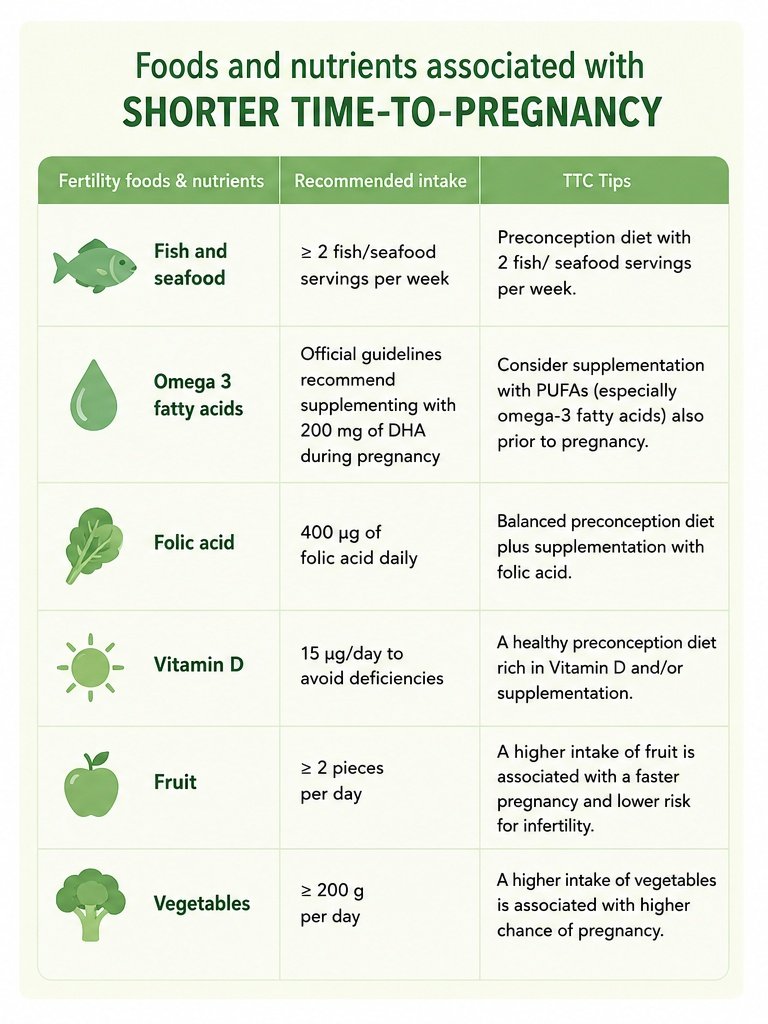
Why PUFAs are Key in Your Preconception Diet:
Polyunsaturated fatty acids (PUFAs)—especially omega-3 fatty acids (such as DHA and EPA) and omega-6s (such as arachidonic acid)—play an important role in fertility for both women and men. PUFAs support healthy ovulation, sperm quality, and early embryo development. [1,5]
In women, a higher intake of omega-3 polyunsaturated fatty acids may support fertility. [1,2] Increased consumption of nuts and seeds, which provide unsaturated fats including omega-6 fatty acids, may benefit male fertility, too.[5]
Excellent dietary sources of omega-3 fatty acids are fatty fish: Salmon, mackerel, herring, sardines, and trout. If you don’t eat fish, you can also back up your preconception diet with an omega-3 fatty acid supplement.
Best dietary sources of omega-6 fatty acids are: Eggs, poultry, beef, pork, fish and seafood as well as nuts, seeds and vegetable oils.
Foods to Avoid or Limit When Trying to Get Pregnant:
Just as some foods can support fertility, others can make it harder for your body to conceive. Below are common foods and drinks to avoid or limit when trying to conceive.
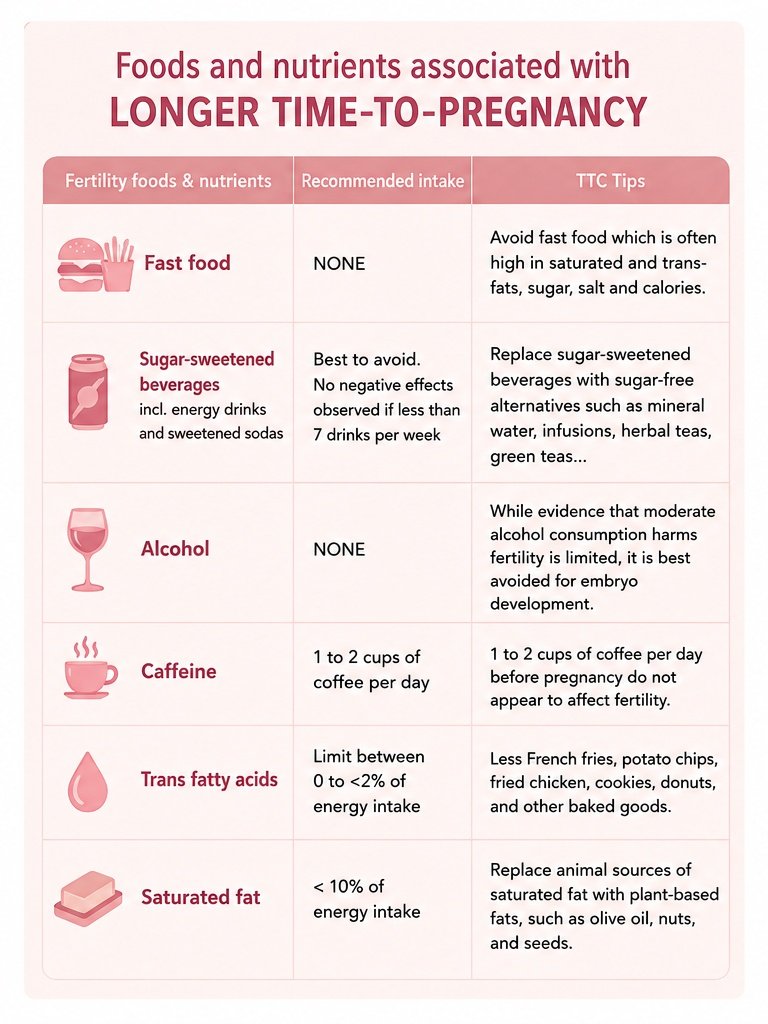
Saturated and trans fats to limit when you are trying to conceive:
Trans fats and high amounts of saturated fat may negatively affect hormone balance and ovulation.
Saturated fats are found in foods such as butter, fatty meats, sausages, cream, cheese and many pastries. They do not need to be eliminated, but replacing some sources of saturated fat with unsaturated fats—such as olive oil, nuts, seeds and fish—is generally a heart-healthy choice.
Trans fats are a different matter. Industrial trans fats are found primarily in some fried and commercially baked foods and are best avoided. Evidence linking trans-fat intake with fertility is mostly observational, so it is more accurate to say that minimizing trans fats supports overall health rather than claiming that they directly cause infertility.
The bottom line: Can diet boost female fertility naturally?
A healthy preconception diet cannot guarantee pregnancy, but it can help create a better nutritional foundation for conception and pregnancy.
Instead of searching for one “fertility food,” build your everyday diet around vegetables, fruit, legumes, whole grains, nuts, seeds, healthy fats and quality protein. Include omega-3-rich foods such as oily fish (or consider a supplement), take folic acid before conception, and limit smoking, alcohol, highly processed foods and excessive caffeine.
Most importantly, think long term. Fertility nutrition is not a three-day cleanse or a list of miracle foods. It is about consistently giving your body the nutrients and healthy lifestyle habits it needs while you try to conceive.
Guest blog by Birgit Reinshagen, BabyBelly Nutrition
References:
- Winter, H.G.; Rolnik, D.L.; Mol, B.W.J.; Torkel, S.; Alesi, S.; Mousa, A.; Habibi, N.; Silva, T.R.; Cheung, T.O.; Tay, C.T.; et al. Can dietary patterns impact fertility outcomes? A systematic review and meta-analysis. Nutrients 2023, 15, 2589.
- Gaskins, A.J.; Sundaram, R.; Buck Louis, G.M.; Chavarro, J.E. Seafood intake, sexual activity, and time to pregnancy. The Journal of Clinical Endocrinology & Metabolism 2018, 103(7), 2680–2688.
- Rogers, L.M.; Cordero, A.M.; Pfeiffer, C.M.; Hausman, D.B.; Tsang, B.L.; De-Regil, L.M.; Rosenthal, J.; Razzaghi, H.; Wong, E.C.; Weakland, A.P.; Bailey, L.B. Global folate status in women of reproductive age: A systematic review with emphasis on methodological issues. Annals of the New York Academy of Sciences 2018, 1431(1), 35–57.
- Cueto, H.T.; Riis, A.H.; Hatch, E.E.; Wise, L.A.; Rothman, K.J.; Sørensen, H.T.; Mikkelsen, E.M. Folic acid supplementation and fecundability: A Danish prospective cohort study. European Journal of Clinical Nutrition 2016, 70(1), 66–71.
- Sharma, R.; Biedenharn, K.; Fedor, J.; Agarwal, A. Lifestyle factors and reproductive health: Taking control of your fertility. Reproductive Biology and Endocrinology 2013, 11, 66.
- Chavarro, J.E.; Rich-Edwards, J.W.; Rosner, B.A.; Willett, W.C. Protein intake and ovulatory infertility. American Journal of Obstetrics and Gynecology 2008, 198(2), 210.e1–210.e7.
- Toledo E, Lopez-del Burgo C, Ruiz-Zambrana A, Donazar M, Navarro-Blasco I, Martinez-Gonzalez MA, et al. Dietary patterns and difficulty conceiving: a nested case-control study. Fertil Steril. 2011;96(5):1149-53.