

As healthcare organizations operate in an ever-changing environment of customer expectation, regulatory requirement, digital change & innovation and financial pressures it is important that all healthcare providers such as hospitals, clinics, diagnostic centers and specialty providers are continually improving the quality of care while at the same time managing costs and maintaining operational efficiency.
Healthcare consulting services provide assistance and expertise to healthcare organizations as they navigate the various challenges facing them.
These solutions include clinical operations consulting, strategic planning, technology implementation, workforce management and regulatory compliance consulting to help these organizations optimize their operations.
Consultants collaborate with healthcare organizations by working alongside personnel from the healthcare organizations rather than taking over their role as internal experts or primary resources, but instead have partnered with them in order to identify opportunities for improvement in their current processes as well as develop practical, sustainable solutions to enhance their overall success.
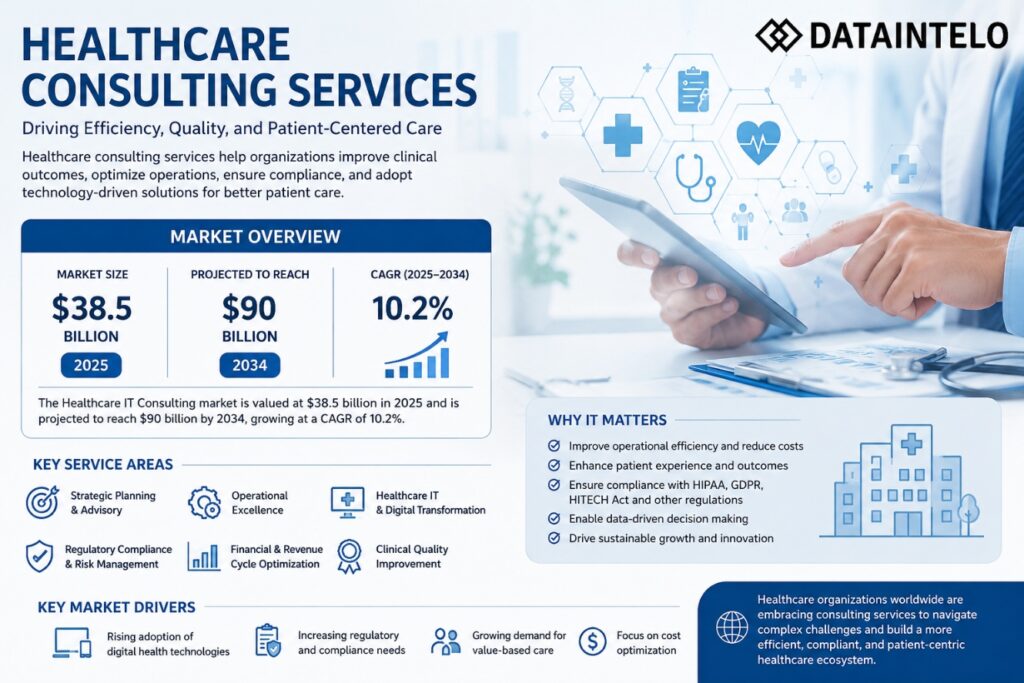
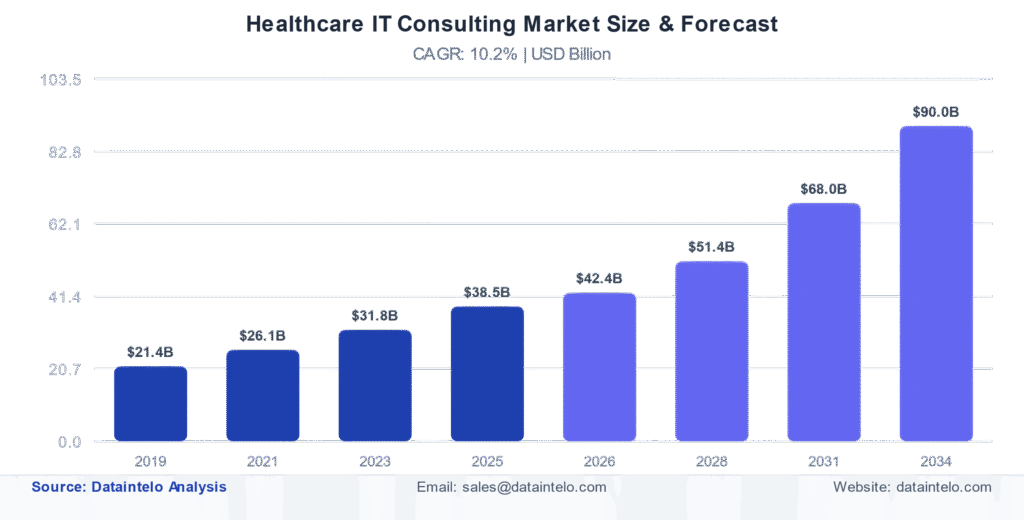
According to industry analysis by DataIntelo, the global Healthcare IT Consulting market is forecasted to grow from $38.5 billion in 2025 to $90 billion in 2034 – representing a compound annual growth rate of 10.2% over the forecast period. Regulatory compliance, such as HIPAA, GDPR, and HITECH Act requirements, are causing a major demand for significantly more specialized consulting services worldwide.

The need for healthcare consulting is consistently increasing as healthcare systems move toward the growing use of electronic health records (EHR), utilize telehealth services, leverage data for decision making, and implement value based care.
As healthcare consultants analyze the current processes of a healthcare organization, they will determine where there are operational gaps and provide recommendations for evidence-based improvements to help provide better patient experiences and organizational performance.
The ultimate goal of healthcare consultants is to help create sustainable systems that improve the delivery of healthcare services and comply with the healthcare industry standards.
Consultation contacts begin with a thorough examination of an organization’s objectives, operational constituents, demographics of the patient population, and challenges faced today.
By performing this assessment, consultants can provide tailored solutions to clients instead of generic solutions.
The areas of focus may involve enhancing patient flow, reducing operations cost, optimizing revenue cycle or improving clinical governance, and therefore can expect measurable results to align with their organization’s strategic planning initiatives.
Core Areas of Healthcare Consulting:
There are several important strategic and operational areas that are generally the main focus of healthcare consulting:
- Planning and Development of Strategy
- Hospital Operations and Optimizing Workflows
- Revenue Cycle Management & Financial Strategies
- Implementing Healthcare IT Systems and Processes
- Preparing for Compliance and Accreditation
- Improvement of Clinical Quality
- Managing Risk & Patient Safety
- Staffing and Other Workforce Strategies
- Integrating Digital Transformation & Telehealth
- Performing Data Analytics & Measuring Results
Developing efficiencies in all of these areas will help to create an organization that is capable of providing a consistent delivery of high-quality patient care.

Benefits of Healthcare Consulting Services:
By investing in healthcare consulting, organizations can make improvements across multiple operations. Consultants provide an independent viewpoint to help identify inefficiencies that are not apparent to internal teams. Additionally, they will establish the industry’s top methods and systems of implementing to lessen operational risks.
Some of the main benefits include:
- Improved operational efficiency
- Increased patient satisfaction/experience
- Increased compliance to regulatory standards
- Improved financial performance
- Decreased administrative burden
- More efficient use of healthcare technology
- Improved clinical workflows More efficient resource utilization
- Heightened employee engagement/productivity
- Long-term sustainability for the organization.
Common Challenges Addressed by Healthcare Consultants:
Healthcare organizations encounter many operational and clinical challenges requiring systematic responses for resolution by utilizing consulting professionals to develop effective solutions to fragmented work environments (among others) and by developing effective solutions to fragmented work environments, high operational costs, shortage of personnel, inconsistent experiences of patients, and barriers to the adoption of technology.
Consulting professionals also assist healthcare organizations’ leaders in managing change within their organizations while maintaining continuity of care for their patients.
Additionally, consulting professionals will develop a structured implementation plan for healthcare organizations during a merger, an expansion to an existing facility, and a digital modernization project, as well as assist with preparing for accreditation.
The Evolution of Technology’s Impact on Healthcare Consulting:
Healthcare organizations now have access to an increasing variety of digital technologies which allow them to gather, analyze, and leverage vast amounts of clinical or operational data to support their decision-making processes.
Consultants assist organizations in assessing technology investments, integrating healthcare software platforms, improving cyber security protocols, and enhancing the ability to share information between different healthcare systems.
Current Technologies Used in Healthcare Consulting:
Technological Factors for Healthcare Success
- Optimizing Electronic Health Records
- Using Telemedicine Platforms
- Using Artificial Intelligence in Clinical Support
- Predictive Analytic Tools for Healthcare
- Cloud Based Healthcare Administration System
- Remote Patient Monitoring Technology
- Business Intelligence Dashboards
- Automating Processes
Successful implementation of these technologies requires careful planning, training of staff on new processes, a redesign of workflows, and continuous evaluation of processes.
Best Practices for Successful Healthcare Consulting:
A successful healthcare consultant’s job provides them the most benefit when their client group participates in the consulting process by working in partnership with the consultant to implement all aspects of the project.
By establishing a good working relationship between the consultant and the leadership of the healthcare organization, there is a strong chance that the consultant’s recommendations can be successfully implemented and achieve both organizational goals and enhance the quality of patient care provided.
An effective healthcare consulting project will typically include:
- Well-defined project objectives
- The involvement of leaders from the healthcare organization throughout the entire implementation process
- Decision-making is based on data
- Continuous monitoring of organization’s performance
- Education and engagement of the workforce
- Implementation of patient-centered quality improvement strategies
- Continuous evaluation of measurable outcomes
- On-going process improvement.
Value of Healthcare Consulting Across Different Healthcare Settings:
| Healthcare Setting | Primary Consulting Focus | Expected Outcome |
| Hospitals | Operational efficiency and clinical workflow | Improved patient care and reduced delays |
| Specialty Clinics | Process optimization | Better appointment management and patient satisfaction |
| Diagnostic Centers | Workflow standardization | Faster reporting and resource utilization |
| Rehabilitation Centers | Care coordination | Improved treatment continuity |
| Multi-site Healthcare Networks | Strategic planning and integration | Consistent quality across locations |
| Telehealth Providers | Digital transformation | Expanded patient access and service efficiency |
Future Outlook:
The many innovations being made in the fields of digital health, personalized medicine, and value-based healthcare delivery are having a major impact on the evolution of healthcare consulting.
The focus of future consulting efforts will include a higher degree of predictive analytics, artificial intelligence and machine learning, integration of care models and sustainability, as well as the improvement of patient experience.
Organizations will benefit from having an edge over their competitors by using methods that are proven to work in order to improve operations and provide better quality patient care through ongoing development and evidence-based practices.
Conclusion:
Organizations that provide consulting services to healthcare providers (e.g., physicians, hospitals/health systems) can play an important role by helping these providers enhance their operational effectiveness and quality of care while adapting to the constantly changing landscape of healthcare.
Consultants in healthcare typically utilize a combination of strategic planning, technological integration, operational experience and established performance improvement methodologies (collective experience) to enable their clients to provide more effective (ie, patient-centered), sustainable healthcare services.
Moreover, the consulting industry will continue to be an integral partner to the evolving healthcare industry through ongoing innovation and improvement initiatives designed to support long-term outcomes for these organizations.