


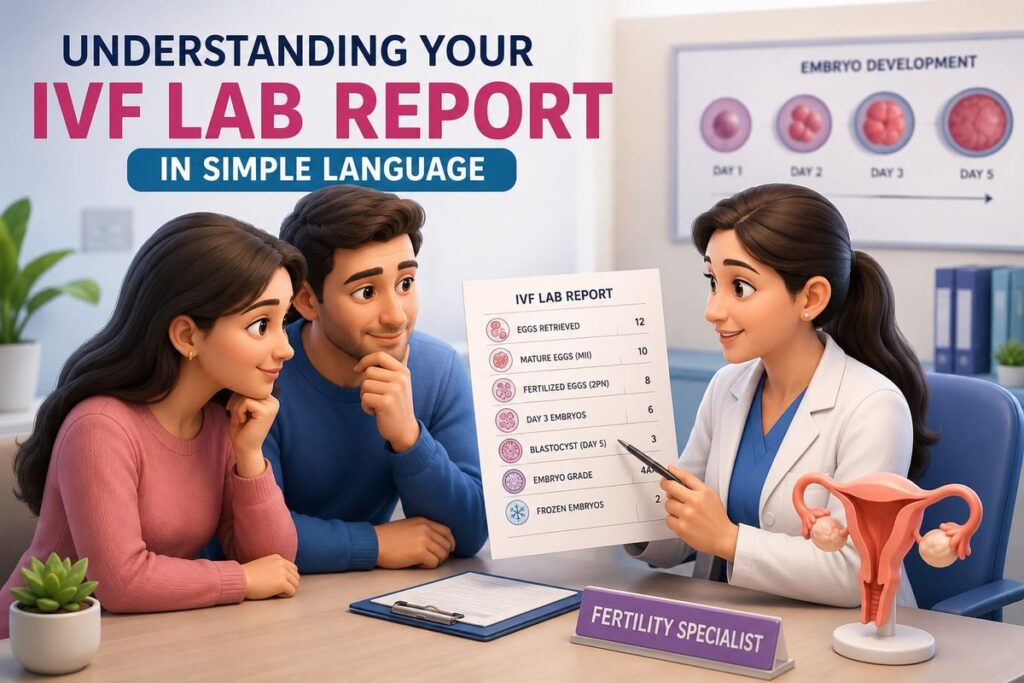
If you are going through IVF treatment, you may receive a lab report after every important step. The report often contains medical terms, numbers, and abbreviations that can be confusing. Many couples look at these reports and wonder, “Is everything normal?” or “Do these numbers mean our IVF cycle will be successful?”
The good news is that you do not need to be a doctor to understand the basics of your IVF lab report. Knowing what each term means can help you feel more confident and ask the right questions during your consultation.
In this guide, we explain the most common terms found in an IVF lab report using simple English. We also share real-life examples to make everything easier to understand.
Why is an IVF Lab Report Important?

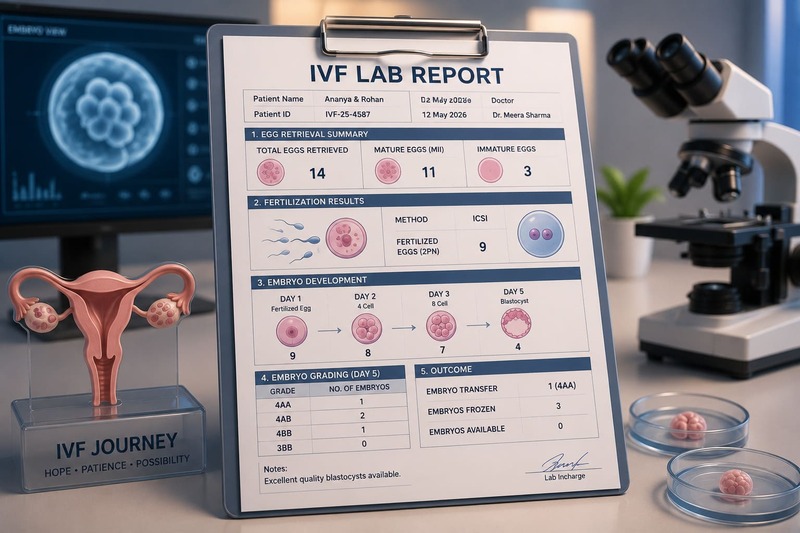
An IVF lab report is a summary of what happened during different stages of your IVF treatment. It helps doctors monitor your progress and decide the next steps.
Your report may include information about:
- Number of eggs collected
- Egg maturity
- Fertilization results
- Embryo development
- Embryo grading
- Embryo freezing
- Embryo transfer details
Remember that every IVF journey is different. A report that looks “average” can still result in a healthy pregnancy.
For example, Rahul and Priya, a couple from Pune, had been trying to conceive for four years. After their egg retrieval, they received a report filled with terms like MII, 2PN, and Blastocyst Grade 4AA.
At first, they were worried because they did not understand these medical words. During their consultation, their fertility specialist explained each term in simple language. They realized that their results were actually encouraging, and one healthy embryo was transferred successfully.
Their experience shows why understanding your IVF lab report can reduce unnecessary stress.
Common Terms You May See in Your IVF Lab Report:

| Lab Report Term | Simple Meaning | Why It Matters |
|---|---|---|
| Eggs Retrieved | Total eggs collected from ovaries | More eggs give more chances, but quality matters most. |
| Mature Eggs (MII) | Eggs ready for fertilization | Mature eggs have the highest chance of fertilization. |
| Fertilized Eggs (2PN) | Eggs successfully fertilized | Shows whether fertilization happened normally. |
| Cleavage Embryo | Embryo growing after fertilization | Indicates healthy early development. |
| Blastocyst | Embryo grown for 5–6 days | Usually has a better implantation chance. |
| Embryo Grade | Quality of embryo | Helps doctors select the best embryo. |
| Frozen Embryos | Healthy embryos stored for future use | Useful if another transfer is needed. |
1. Number of Eggs Retrieved:
This is one of the first numbers on your IVF report.
It tells you how many eggs were collected during the egg retrieval procedure.
For example:
| Patient | Eggs Retrieved |
| Priya | 12 |
| Sneha | 8 |
| Neha | 18 |
Many couples believe that collecting more eggs always means better success. This is not true.
A woman with 8 good-quality eggs may have a better outcome than someone with 20 poor-quality eggs.
Doctors focus on quality first, quantity second.
2. Mature Eggs (MII):
Not every collected egg is ready for fertilization.
The report may mention:
- MII (Mature)
- MI (Nearly mature)
- GV (Immature)
Only MII eggs are usually used for IVF or ICSI.
Example:
Priya’s report showed:
- Eggs Retrieved: 12
- Mature Eggs (MII): 10
This means 10 eggs were suitable for fertilization.
3. Fertilization Result (2PN):
After IVF or ICSI, doctors check whether fertilization has happened normally.
You may see:
2PN
This means the egg has one nucleus from the mother and one from the father.
It is considered normal fertilization.
Example
Rahul and Priya’s report:
| Stage | Result |
| Mature Eggs | 10 |
| Fertilized Eggs (2PN) | 8 |
Eight embryos started developing normally.
4. Embryo Development:
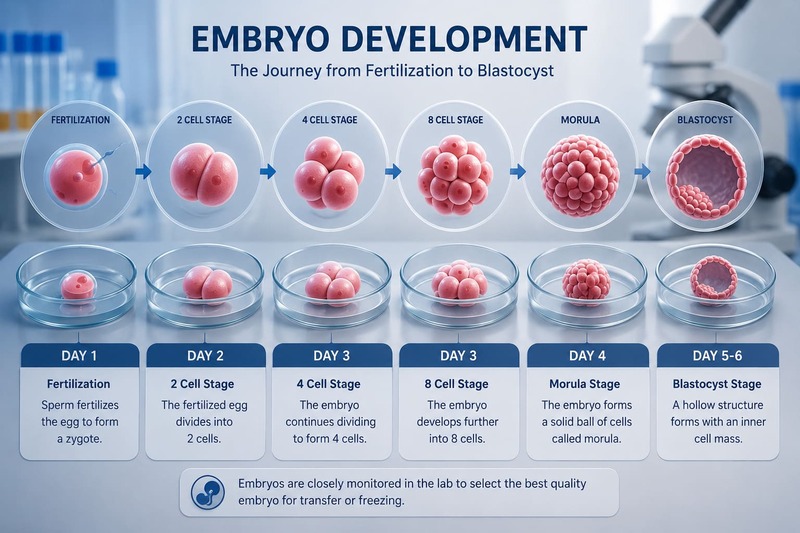
After fertilization, embryos continue to grow every day.
Your report may include the development day.
| Day | Stage |
| Day 1 | Fertilized Egg |
| Day 2 | 2–4 Cells |
| Day 3 | 6–8 Cells |
| Day 4 | Morula |
| Day 5 | Blastocyst |
| Day 6 | Expanded Blastocyst |
Doctors monitor embryo growth every day.
Not every embryo reaches the blastocyst stage, and this is completely normal.
5. What is a Blastocyst?
A blastocyst is an embryo that has grown for about five or six days.
Many fertility specialists prefer transferring a healthy blastocyst because it has already shown good development.
However, some couples may have successful pregnancies with Day-3 embryos as well.
6. Understanding Embryo Grading:
One of the most confusing parts of an IVF report is embryo grading.
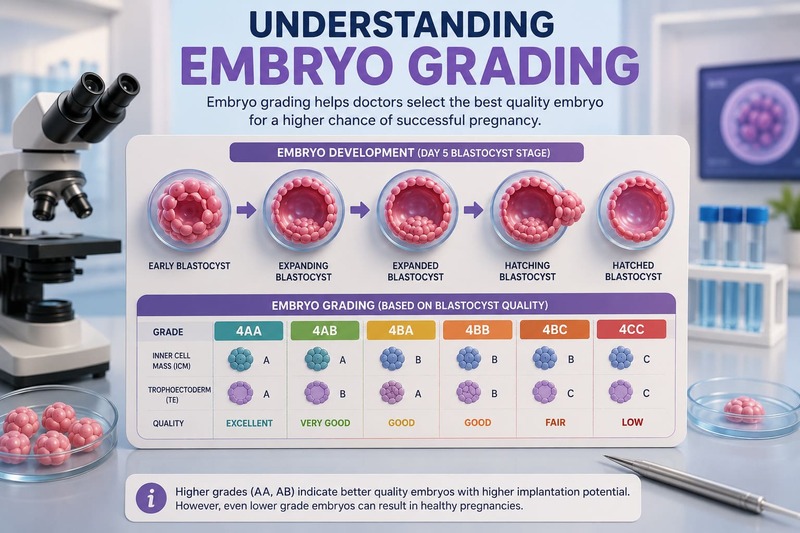
You may see something like:
- 4AA
- 5AB
- 3BB
These letters describe the appearance of the embryo under a microscope.
| Grade | General Meaning |
| AA | Excellent quality |
| AB | Very Good |
| BA | Good |
| BB | Good to Average |
| BC | Fair |
| CC | Lower quality |
It is important to remember that grading only describes appearance.
It does not guarantee pregnancy or predict the baby’s health.
Many healthy babies have been born from BB-grade embryos.
Rahul and Priya had:
- One 4AA embryo
- One 4BB embryo
Their doctor transferred the 4AA embryo and froze the 4BB embryo for future use.
7. What Does Frozen Embryo Mean?
If there are good-quality embryos remaining after transfer, they may be frozen.
These embryos can be used later without repeating egg retrieval.
Benefits include:
- Lower treatment cost in future cycles
- Less medication
- Faster treatment
- Another pregnancy opportunity
Also Read: What is a Good Progesterone Level for Frozen Embryo Transfer (FET)?
8. Understanding ICSI Mentioned in the Report:
Some reports mention:
ICSI Performed
ICSI stands for Intracytoplasmic Sperm Injection.
Instead of allowing sperm to fertilize the egg naturally in the laboratory, one healthy sperm is injected directly into the egg.
Doctors usually recommend ICSI when there is male infertility or previous fertilization failure.
9. Why Some Eggs Do Not Fertilize:
Many couples become anxious when not all eggs fertilize.
This is completely normal.
Possible reasons include:
- Egg quality
- Sperm quality
- Chromosomal abnormalities
- Natural biological process
For example:
Collected Eggs: 15
Mature Eggs: 12
Fertilized Eggs: 8
This does not mean something went wrong.
It simply reflects the natural selection process.
Must Read: How Many Injections Are Needed for IVF Treatment?
10. Why Some Embryos Stop Growing:
Another common concern is embryo arrest.
Some embryos stop developing before Day 5.
This can happen because of:
- Chromosomal abnormalities
- Poor egg quality
- Poor sperm quality
- Natural embryo selection
Even in the best IVF laboratories, not every embryo becomes a blastocyst.
11. Should You Compare Your Report With Others?
No.
Every couple’s fertility journey is unique.
Example
Couple A
- 20 eggs retrieved
- 2 blastocysts
Couple B
- 8 eggs retrieved
- 2 blastocysts
Both couples have the same number of embryos available for transfer.
Comparing numbers with friends or people on social media often creates unnecessary anxiety.
Questions You Should Ask Your Fertility Specialist:


Instead of worrying about medical terms, ask questions like:
- How many mature eggs were collected?
- How many embryos reached the blastocyst stage?
- Which embryo grade will be transferred?
- Are there embryos available for freezing?
- What are the next steps in my treatment?
These questions help you understand your progress much better than trying to interpret every abbreviation on your own.
Quick Reference Table:
| Report Item | What It Means |
| Eggs Retrieved | Eggs collected from ovaries |
| Mature Eggs | Eggs ready for fertilization |
| 2PN | Normal fertilization |
| Cleavage Embryo | Early embryo development |
| Blastocyst | Five-day-old embryo |
| Embryo Grade | Appearance and quality of embryo |
| Frozen Embryo | Embryo stored for future treatment |
| Embryo Transfer | Placing embryo into the uterus |
Final Thoughts:
Receiving an IVF lab report can feel overwhelming, especially if it is your first treatment cycle. The medical terms and numbers may seem difficult, but they tell the story of your IVF journey step by step.
Remember that one healthy embryo is all it takes to achieve a successful pregnancy. A report with fewer eggs or average embryo grades does not mean your treatment will fail.
Like Rahul and Priya, many Indian couples initially worry after reading their IVF report. Once their fertility specialist explains the results in simple language, they realize that every stage of IVF is part of a carefully monitored process.
If you have questions about your report, never hesitate to ask your fertility doctor. Understanding your results can reduce stress, improve communication with your healthcare team, and help you feel more confident throughout your fertility journey.
Disclaimer: This article is for educational purposes only and should not replace medical advice, diagnosis, or treatment from a qualified fertility specialist. Always discuss your IVF lab report and treatment results with your doctor, as every couple’s fertility journey and medical condition are unique.